


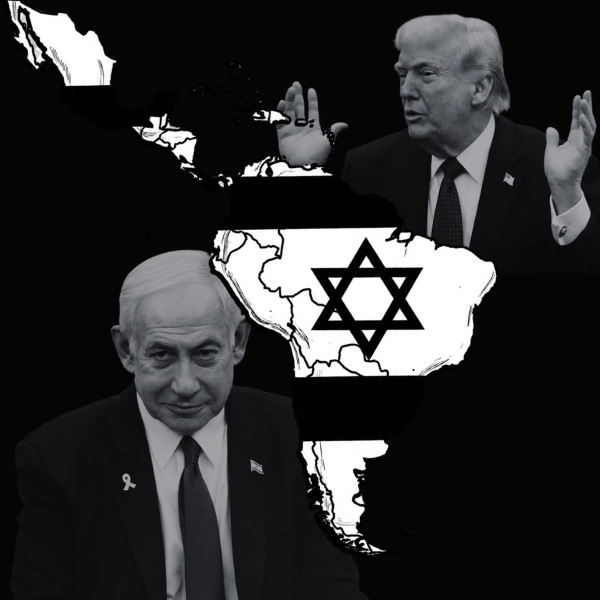
While the world is distracted by the senseless war in Iran, the Hantavirus, and the slow decline of the last Western empire, something was brewing here on the continent.
A series of recordings leaked by investigative journalists in Honduras and the Spanish news platform Canal Red have revealed the behind-the-scenes plan of the United States and Israel. It is a campaign to promote their interests in Honduras and destabilize left-wing governments in Latin America, according to Middle East Eye.
And yes, this may sound like “nothing new” to some, especially given the United States’ history of political interventionism on the continent. However, the investigation, led by anonymous Honduran journalists, reveals a macabre plan that goes beyond even the most dystopian of imaginations.
The investigators had access to 37 leaked voice notes from WhatsApp, Signal, and Telegram that, according to what’s now called “Hondurasgate,” have been authenticated through forensic analysis. They were recorded between January and April 2026. The website that published the 37 recordings, making them available in their entirety, explains that each file was analyzed using the Phonexia Voice Inspector protocol, a forensic suite from the Czech company of the same name, founded in 2006 and used in more than 60 countries by intelligence agencies, law enforcement, banks, and media outlets.
The first finding of the investigation was that the recordings appear to indicate that Israeli interests were behind U.S. President Donald Trump’s pardon of former Honduran President Juan Orlando Hernández.
For those who don’t recall, in December of last year, Trump pardoned Hernández, who was serving a 45-year prison sentence following a U.S. federal court conviction on drug trafficking charges.
At the time, many of us questioned the U.S. president’s decision, given that he had campaigned for years against drug trafficking—a stance he used to justify intervention in Venezuela and the bombing of ships in the Caribbean.
Shortly thereafter, Trump endorsed the then-presidential candidate of Palestinian origin, Nasry Asfura, who was running against his centrist opponent Salvador Nasralla, and threatened to cut aid to the country if Asfura lost the election.
The question was, what is Trump’s interest in Honduras? We now know that it was not in the interest of the U.S. administration but of Israel.
What interest does Israel have, then?
Hernández, known as JOH, served as president of Honduras from 2014 to 2022 as a member of the conservative-leaning National Party. Those were years of supposed cooperation with the United States in the fight against drug trafficking. In 2024, he was sentenced in Manhattan to 45 years in prison for associating for more than a decade with drug traffickers who paid him bribes to ensure that more than 400 tons of cocaine reached the northern border of the Rio Grande. According to El País, three years earlier, his brother Juan Antonio Hernández had been sentenced to life in prison for the same crimes. The U.S. Attorney’s Office for the Southern District of New York had accused JOH of receiving $1 million from Mexican drug trafficker Joaquín “El Chapo” Guzmán.
According to new leaks from “Hondurasgate,” Trump’s pardon of JOH, days before the elections in Honduras, was not clemency, but rather the initial payment in a larger agreement. In one of the recordings, Hernández explains it directly, though without revealing his interlocutor: “The pardon money didn’t even come from you. It came from a group of rabbis and people who supported Israel.” In another audio recording, he says that Israeli Prime Minister Benjamin Netanyahu had “everything to do” with his release and the negotiations that made it possible.
The investigation into “Hondurasgate,” which includes voice messages from Asfura following private meetings at Trump’s Mar-a-Lago resort, reveals plans to establish a new U.S. military base in Honduras, expand private “economic development” zones, and encourage investment by U.S. artificial intelligence companies.
According to the investigation, Asfura’s election was intended as a transitional step before an alleged plan backed by the United States and Israel to have Hernández take power in the upcoming presidential elections.
In a January 20 voice note, Hernández said that “the prime minister of Israel is going to support us.” He added that “they [the Israelis] had everything to do with my departure and negotiation,” referring to Trump’s pardon.
In a March 14 voice message, Hernández credited the money for his pardon to “a group of rabbis and people who supported Israel.”
The investigation also includes messages from Hernández to the president of the National Congress of Honduras, Tomás Zambrano, in which the former instructed Zambrano to undermine Asfura’s power with Israeli support.
“I sent you the people of Israel; they sent you money. I’m the one doing the lobbying,” the former president said.
The plan extends beyond Honduras.
The investigation also included conversations between Hernández and Asfura about creating a “digital journalism unit” funded by the Honduran government and the U.S.-backed Argentine president, Javier Milei, to launch media attacks against the governments of Colombia and Mexico.
The second installment from the investigators includes a recording of an alleged conversation between Hernández, Asfura, and his vice president, María Antonieta Mejía. The goal would be to undermine the governments of Claudia Sheinbaum and Gustavo Petro.
In the conversation between Hernández and Asfura, the former president tells the Honduran leader that he needs $150,000 to rent an apartment in the United States, where he plans to set up an office for a digital journalism unit. This unit would “publish information about Manuel Zelaya,” who accused Trump of “protecting the plunderer of the state,” referring to Hernández’s pardon last November, and about Xiomara Castro, who served as president until handing power to Asfura. “Someone else here, from the U.S. president’s team, will handle it for me. Well, he’s one of the Republicans who are helping us. They’re going to set up a news site for us.”
Asfura’s response is: “I’m going to transfer it from a friend’s account. Let’s see if they can give it to you in cash, but explain to me, what are we going to do with it, what do we gain?” Hernández replies: “We’re going to set up a cell, Mr. President. From here, from the United States, an information cell, so they can’t track us there in Honduras. It’s going to be like a Latin American news site. I was on a call with President Javier Milei, and it was successful. Very, very, very good, and I think that at this point we can do great things for all of Latin America. There are some cases coming up against Mexico, some cases coming up against Colombia, and, most importantly, against Honduras, against the Zelaya family.”
“Also, I think you need a little more money for yourself. So we’re going to send another $150,000. And that way, you can survive a little longer. “We’re going to take it from INSEP [Secretariat of Infrastructure and Public Services],” Asfura says. On the same topic, in another alleged communication between the former Honduran president and the current vice president, Hernández emphasizes the importance of having that liquidity, “with the support of some Republicans,” to “attack and eradicate the cancer of the left” in Honduras and throughout Latin America.
“I was telling President Asfura that we were able to speak with Javier Milei, and he’s also contributing $350,000. Another great friend of ours from Mexico is also providing support, specifically for the Mexican community. We’re pretty much ready and hoping this moves forward quickly,” Hernández added.
For her part, Mexican President Claudia Sheinbaum, during her morning press conference this Wednesday, said she listened to the audio recordings and reviewed part of the news reports. The Mexican president again sent a message to Isabel Díaz Ayuso, regional premier of Madrid, who is currently on a tour in Mexico as part of an international right-wing network linked to groups in Spain, the United States, and Argentina that spread fake news because “they don’t like Mexican humanism” and “prefer to worship Hernán Cortés.”
“They can set up a smear campaign office against our government in Honduras, using resources from a friendly nation. It won’t affect us, not at all. There may be days of confusion, but if we remain true to our principles, know what we must do within the framework of our Constitution and the laws, and respect sovereignty, no one will be able to undermine the transformation project. It’s that clear,” Sheinbaum stated.
Meanwhile, in September 2025, the U.S. government announced its intention to revoke Colombian President Gustavo Petro’s visa after he joined a pro-Palestine demonstration in New York City and urged U.S. soldiers to “not point their guns at people” and to “disobey Trump’s orders.”
For his part, Argentine President Javier Milei has promoted relations between Israel and Argentina with U.S. support, fostering economic cooperation and announcing plans to move the Argentine embassy to Jerusalem.
Israel has a long history of interventionism in Latin America.
Latin American presidents such as Gustavo Petro, Lula da Silva, and Sheinbaum herself have opposed Israel’s genocide against the Palestinian people. However, they have been among the few to speak out in recent years.
In contrast, the region’s right wing has always maintained ties with Israel. As president of Brazil (2019–2022), Jair Bolsonaro expanded security cooperation with the Israeli military and visited the Western Wall alongside Israeli Prime Minister Binyamin Netanyahu. Argentine President Javier Milei (who calls himself a “fan of Israel”) promised to move Argentina’s embassy to Jerusalem and pledged to maintain his “unwavering commitment to the State of Israel and its people in the fight against Islamic terrorism, for peace and freedom.”
The relationship between Latin America and the Middle East dates back to the late 19th and early 20th centuries, when waves of Palestinian, Syrian, and Lebanese immigrants left the crumbling Ottoman Empire and settled in South and Central America. Today, their descendants number in the tens of millions, including approximately 700,000 Palestinians. While this diaspora has strengthened support for Palestine, the region’s solidarity is rooted in more than just ancestry. Latin America has suffered the same tactics of state terrorism that Palestine faces at the hands of regimes armed, trained, and advised by Israel.
Israel proved to be an indispensable ally to the dictatorships and military juntas that ravaged Latin America in the late 20th century. For example, Israel’s oldest ally in the region is Nicaragua, where the ruling Somoza dynasty provided weapons and diplomatic cover to the Haganah (a militia of Zionist settlers) between 1939 and 1948. In return, Israel began selling automatic weapons, tanks, and military aircraft to the autocracy in the 1950s. Inspired by the examples of Algeria and Cuba, the Sandinista National Liberation Front (FSLN) was founded in 1961 to lead a revolution against the regime.
Similarly, the largest single recipient of Israeli arms in Latin America during the Cold War was Argentina’s fascist military junta. After seizing power in 1976, the regime launched the so-called “Dirty War” against students, intellectuals, trade unionists, human rights activists, journalists, and anyone else suspected of leftist sympathies. Between 1978 and 1983, Israel sold more than $1 billion in military equipment to the junta, during whose rule more than 30,000 people were murdered. Among those kidnapped, tortured, and executed, Argentine Jews were disproportionately represented. Investigations later revealed that the regime murdered 2,000 Argentine Jews, while Tel Aviv’s arms sales to Argentina continued uninterrupted.
And in Guatemala, Israel’s role became evident after the United States suspended military aid in 1977, and Tel Aviv became the government’s primary source of arms and training. General Benedicto Lucas García, later prosecuted for mass killings, stated that “we consider the Israeli soldier to be the best soldier in the world today, and we take him as a model and example.”
So, while the findings of Hondurasgate do not tell a new story, they do show how, in the end, decisions regarding much of Western international policy, both within and outside Latin America, have always been in the hands of Tel Aviv.