


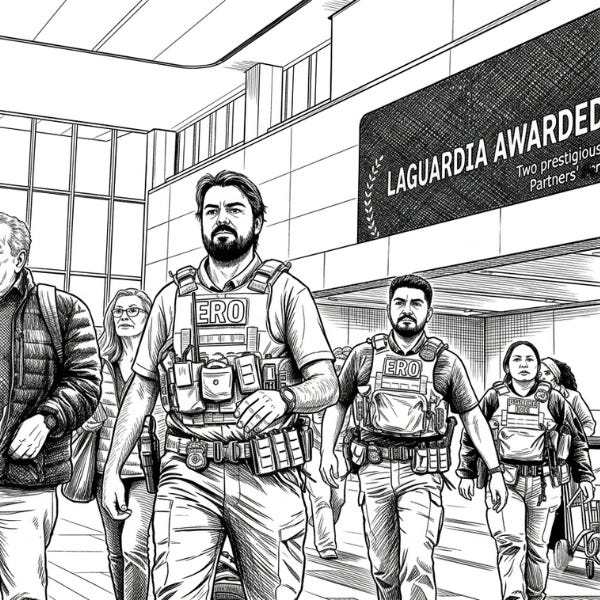
Airports are now part of the administration’s broader show of force. According to The Washington Post, ICE officers were sent to at least 14 airports in March, officially to help with crowd control, exit lanes, and line management during TSA staffing shortages. They were not supposed to check IDs or screen passengers. However, their presence still raised obvious concerns because, as immigration lawyers told the Post, ICE officers in an airport still carry the same authority they would have in any other public place.
That means this is the practical question travelers need to answer before they leave for the airport: what can they legally do, what can they not do, and how can they protect themselves and their loved ones without making a bad situation worse?
First, know who you may be dealing with
At airports, you may encounter TSA officers, local airport police, ICE officers, Customs and Border Protection officers, or Homeland Security Investigations agents. The ACLU’s airport enforcement guide notes that at the border or ports of entry, you are especially likely to encounter CBP and sometimes HSI, which is part of ICE.
TSA’s role is security screening. ICE’s role is immigration enforcement. CBP’s authority is broader at ports of entry than ICE’s is in an ordinary domestic airport setting. According to the Post, if ICE officers are simply standing in an airport in their capacity as ICE agents, they have the same authority they would have in any public place, not some magical airport superpower.
The biggest thing to understand: there are no ICE-free zones in the airport
The Post reports that ICE can approach travelers anywhere in the airport, not just at the checkpoint. That includes the terminal, the security line, the gate, or a coffee line. The practical advice from immigration attorney Nicole Hallett: stay aware of your surroundings the entire time you are there, not just while going through security.
For undocumented people, the risk is higher. The ACLU’s guide says noncitizens without current legal status should consider the risks of flying, including on domestic flights, and notes that TSA has provided lists of travelers to ICE.
If ICE approaches you, do not run and do not volunteer more than you have to
According to the Post, if an ICE officer approaches you and starts asking questions, the safest immediate move is not to run. Running may escalate the encounter. Instead, you can calmly say that you are exercising your right to remain silent.
For domestic travel, the Post also notes that, by law, you do not have to carry proof that you are a U.S. citizen or lawful resident. That said, if you are a noncitizen with lawful status and fear profiling, carrying documentation may help resolve an encounter more quickly.
The ACLU’s airport rights guide adds an important distinction. U.S. citizens generally only need to answer questions establishing identity and citizenship. Lawful permanent residents usually only need to answer questions establishing identity and permanent residency. Visa holders and visitors face more risk if they refuse to answer questions, especially at the border.
ICE cannot automatically search your phone just because you are in an airport
According to the Post, ICE officers at an airport cannot, without a warrant, search your carry-on, phone, or laptop simply because they are present in the airport. They can conduct only those kinds of searches if they are acting under the authority of the agency that has that search power in that setting, such as TSA at a domestic checkpoint or CBP at a port of entry.
But at the border, the legal terrain gets much worse. The ACLU’s airport guide says customs officers sometimes ask travelers to unlock devices or provide passwords when entering or leaving the United States. U.S. citizens cannot be denied entry for refusing, though refusal may lead to delays or the seizure of a device. Lawful permanent residents should generally not be denied entry, though delays and confiscation can still occur. Visa holders and tourists face a greater risk if they refuse. If an officer confiscates a phone or laptop, the ACLU says to get a receipt.
So protect your devices before you travel
According to The Intercept, there are a few key things to keep in mind regarding digital security, especially for journalists, organizers, immigrants, or anyone carrying sensitive information.
They suggest that before you leave:
Use a strong alphanumeric passcode, not Face ID or fingerprint unlock.
Turn biometrics off entirely.
Power your phone fully down before security. Do not just lock it.
Carry a paper boarding pass if possible, so you do not need to power the device back on in line.
Log out of apps you do not need.
Delete sensitive chats, files, and contacts from the device you are traveling with.
If possible, travel with a clean secondary device instead of your primary phone.
The reasoning is: if authorities get access to your device, the safest device is the one that contains as little as possible. The Intercept also warns that if you refuse to unlock a device, you may be delayed, hassled, or have the device confiscated. That does not mean you lose the right to refuse, but you should prepare for the consequences in advance.
TSA still has limits, too
The ACLU’s airport guide makes clear that TSA officers can screen you and your belongings, but they cannot arrest you. They may search bags further, even if the first screening shows nothing suspicious. Still, they may not select you for a personal search or secondary inspection based on religion, race, national origin, gender, ethnicity, or political beliefs.
If you wear a religious head covering, the ACLU says you have the right to wear it through screening. If TSA insists on further screening, you can request that any pat-down or removal happen in a private area and, where relevant, by someone of your gender.
If you are traveling with children, the ACLU notes that children can opt out of an airport scanner, though there is no blanket exemption from pat-downs. Children under 13 may keep shoes, light jackets, and headwear on during screening. If you are carrying breast milk or formula, TSA must allow it in quantities larger than the standard liquid limit, though it may be inspected or tested.
If you are delayed for a long time, say so clearly
The ACLU guide says that if questioning becomes intrusive or improper, you can ask to speak to a supervisor. If you are being detained for an unusually long period, you should ask to contact an attorney or a legal services organization. If an officer tells you that you are under arrest, or it becomes clear they suspect you of a crime, ask for a lawyer before answering more questions. If you want to invoke your right to remain silent, say it out loud.
What families should do before they leave home:
Have one folder, physical or digital, with the documents you may need.
Memorize or write down at least one emergency phone number.
Decide in advance who will be called if someone is detained.
Tell your loved ones your flight number, route, and departure and arrival times.
If someone in your family is undocumented or has a precarious status, talk honestly about the risk before traveling at all.
My reflection is summarized in one word: fear. Beware, ICE agents are now on airports. This reminds me Iran. When I stepped off Tehran train, the first thing I heard was: beware, he's an agent. More here: https://nomadicmind.substack.com/p/too-much-said