


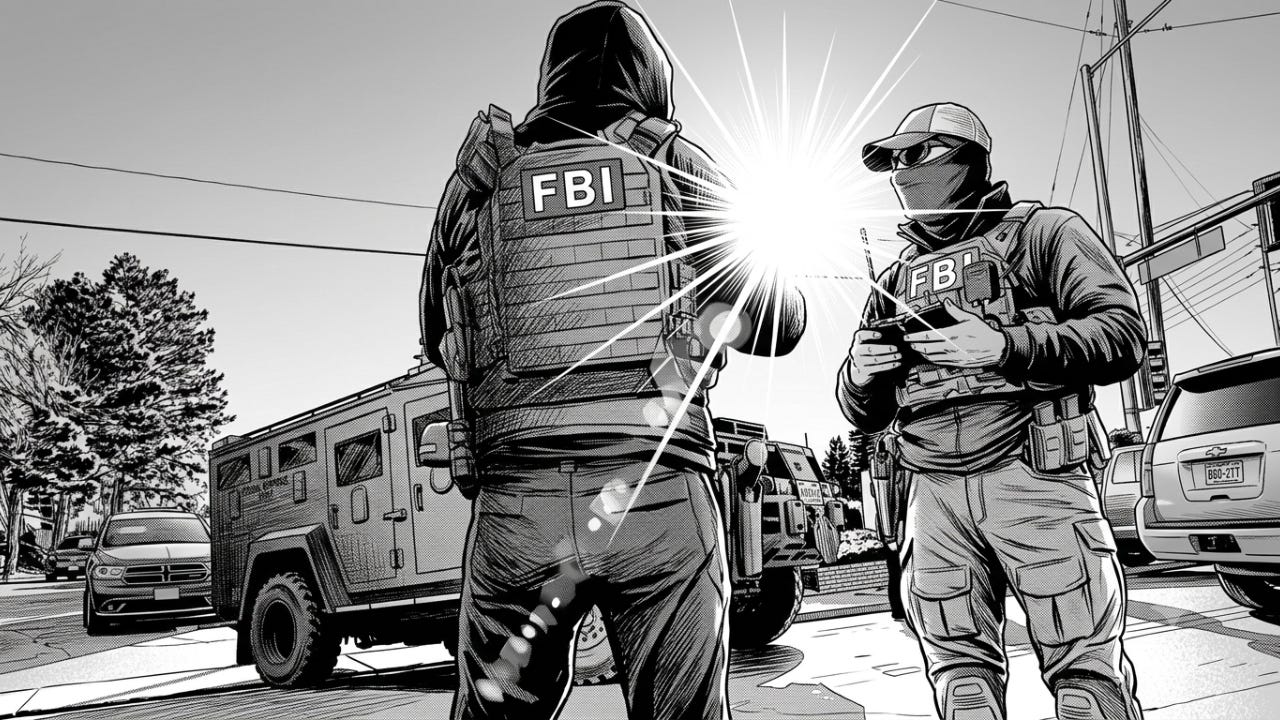
On Thursday, July 16, an email was sent to FBI field offices around the country. It was not, by any means, an announcement of a policy shift. It asked agents to compile a list of their open investigations into assaults on federal officers so that those cases could be handed off, according to emails reviewed by CBS News. A second email, sent that same day to Homeland Security Investigations agents in one field office, made the destination clear: HSI, the investigative arm of Immigration and Customs Enforcement, would now be the one deciding whether its own officers had been attacked before they opened fire.
The New York Times first reported the change on July 19. CBS News independently reviewed emails confirming the shift. The FBI would indeed step back from investigating claims that ICE agents had been assaulted, including in cases where those claims preceded a shooting. The Justice Department and the Department of Homeland Security both denied it, in nearly identical language, on the same afternoon.
What the FBI Was Actually Investigating
Reading the fine print is crucial here because it explains why career law enforcement officials found the change alarming. Federal law makes it a felony, punishable by up to eight years in prison, to “forcibly assault, resists, opposes, impedes, intimidates or interferes” with a federal officer. For the past year, per Common Dreams, the Trump administration has pushed prosecutors to bring that charge as often as possible, arguing that any physical contact with an agent qualifies. Acting Attorney General Todd Blanche told CNN in May that it is “abhorrent to ever, ever touch a law enforcement officer,” and that his office would prosecute accordingly.
The FBI has historically been the agency that determined whether those assault claims held up. Several of the fatal shootings under scrutiny this year have involved both kinds of inquiry at once, with DHS alleging its agents were assaulted just before they opened fire. An assault investigation and a civil rights investigation, in other words, have often run through the same evidence. Under the new guidance, HSI takes the assault claim instead. HSI does not have jurisdiction over civil rights violations, and it is not built to process an officer-involved shooting: no dedicated ballistics unit, no standard forensic pipeline for these cases, no history of large-scale witness canvassing. HSI’s usual caseload runs to human trafficking, cybercrime and art smuggling.
“The fox is guarding the hen house,” said Aaron Reichlin-Melnick, a senior fellow at the American Immigration Council, in a post cited by Common Dreams. For his part, journalist Sam Stein said the guidance amounted to “pure impunity for ICE to do horrible things.”
A Denial That Doesn’t Match the Paper Trail
DHS and the Justice Department answered the reporting with a joint statement, posted on X and repeated to every outlet that asked. “The relationship between DHS and DOJ in investigating assault on federal officer cases has not changed, and the FBI will continue to investigate in accordance with agency policy,” the statement read. “This administration has been clear: anyone who assaults law enforcement will be prosecuted to the fullest extent of the law.”
Similarly, a Justice Department official said Monday morning that the FBI was unaware of any such guidance being sent to field offices. Later that same evening, CBS News reviewed a second email, this one addressed to HSI agents, confirming the shift was already underway. Multiple sources told CBS that the directive had gone out the previous Thursday and was reiterated on Monday, even after DOJ and DHS issued denials.
Two ICE Killings in Six Days
The timing is loud. On July 7, an ICE agent in an unmarked car shot and killed Lorenzo Salgado Araujo, a 52-year-old construction worker, as he picked up his crew in Houston’s Magnolia Park neighborhood. DHS said he had rammed an agent’s vehicle and refused commands. His family disputed that account and said he had no way of knowing the unmarked car following him belonged to federal agents. Six days later, in Biddeford, Maine, an ICE agent shot and killed Johan Sebastián Durán Guerrero, a 25-year-old Colombian national, during a traffic stop that witnesses described as chaotic, carried out by agents in an unmarked vehicle. DHS Secretary Markwayne Mullin told Sen. Angus King that the agent had acted after his vehicle was “weaponized” against pursuing officers. Neither agent was wearing a body camera, despite a February 2026 announcement from then-DHS Secretary Kristi Noem that the agency would deploy them, following two earlier killings in Minneapolis.
Those two deaths brought the total number of people killed in encounters with federal immigration officers since the start of the second Trump administration to at least ten, according to the Associated Press. Deaths in ICE custody, a separate count, have reached 52 in the administration’s first 500 days, a rate Human Rights Watch says has repeatedly surpassed the worst single month of the last decade, May 2020.
Why the FBI Was Ever in the Room
The pattern predates Houston and Biddeford. In January, an ICE agent shot and killed Renee Good, a U.S. citizen, in Minneapolis. DHS said she had tried to hit the agent with her vehicle. Local officials and witnesses disputed it. That same month, an agent shot and killed Alex Pretti, also a U.S. citizen, in the same city. Officials said he had threatened agents, a claim Reuters reported was contradicted by video evidence. In October, agents shot Chicago-area resident Marimar Martinez five times after accusing her of ramming their vehicles; she survived, the charges against her were dropped, and bodycam footage undercut the government’s account.
When HSI was initially tasked with leading the investigation into Pretti’s death, with the FBI in a supporting role, current and former federal law enforcement officials raised questions about the decision, CBS News reported.
When the Justice Department Leans the Other Way
The Minneapolis cases also show what happens when the Justice Department leans the other way. Federal prosecutors were pressured to treat the Good investigation as a straightforward assault case rather than a civil rights matter, a decision that prompted several prosecutors and an FBI agent to resign. A New York Times investigation cited by Common Dreams found the administration has filed assault charges against more than 550 people accused of attacking federal immigration officers. Of the roughly 400 cases resolved so far, nearly half ended in charges being thrown out or withdrawn, or in acquittals.
Those numbers sit uneasily next to the government’s own language. Officials have repeatedly described federal agents as targets of sustained violence to justify enforcement tactics and, in Houston and Biddeford, the shootings themselves. Removing the FBI from assault investigations means the agency most likely to gather evidence undercutting that narrative, as it did with Pretti, Good and Martinez, is no longer positioned to do so as a matter of course.
What Happens Now to Houston and Biddeford
The Justice Department, the FBI and DHS did not respond to questions from CBS News about how the policy shift might affect the investigations already open in Texas and Maine. In Houston, the Harris County District Attorney’s office said federal authorities are “exclusively handling all aspects” of the case, with the FBI’s field office there previously confirming it was investigating the alleged assault on an agent, separate from the shooting itself. In Maine, the state attorney general’s office said it was investigating alongside the FBI, and the agent involved, later identified by relatives as David Brouillette, was placed on administrative leave. Under the new guidance, the assault claims underlying both agencies’ official accounts, the claims that Salgado Araujo tried to run over an officer and that Durán Guerrero’s vehicle was “weaponized” against agents, would fall to HSI to examine.
After concerns were raised inside federal law enforcement over HSI’s initial role in the Pretti case, the FBI and the Justice Department’s Civil Rights Division were ordered to take the lead instead. That investigation is still open.