


We’re starting the week with a contradiction the White House can no longer hide: the spectacle of power is still there, but so are the cracks. From the largest single day of protest in U.S. history to a sudden retreat on Cuba oil and a Pentagon argument that edges toward criminalizing journalism itself, here’s the news we’re watching as the week begins.
The country kept showing up
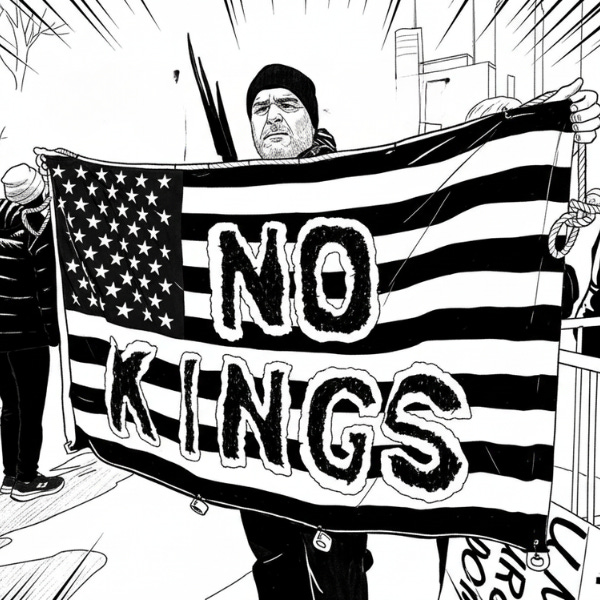
The third No Kings protest drew more than 8 million people across more than 3,300 events in all 50 states and more than a dozen countries, according to organizers cited by The Guardian. That makes it the largest number of protests in a single day in U.S. history.
What stands out is not only the scale but the geography. Organizers said nearly half of the events took place in traditionally red or battleground states, and more than two-thirds of people who RSVP’d were outside major urban centers. In other words, this was a national warning flare.
The issues pulling people into the street were also tellingly broad: ICE raids, the war in Iran, voting rights threats, trans rights, labor rights, Palestinian solidarity, and the basic question of whether the country is sliding toward something openly authoritarian. In Minnesota, where federal agents killed Renee Good and Alex Pretti earlier this year, the protest carried the weight of mourning as much as resistance. In New York, the theme was democracy. In Chicago, it was anti-fascism and protection for immigrant and trans communities. Across cities and rural towns alike, the throughline was simple: people are seeing the connections.
That is why the White House response felt so brittle. Dismissing millions of people as participants in “Trump Derangement Therapy Sessions” fell, well, short. It is the language of an administration that knows the backlash is no longer a partisan issue.
Trump blinked on Cuba
After months of trying to choke off fuel to Cuba, Trump said Sunday he would not stop a Russian tanker carrying oil to the island. According to The Washington Post, the Hong Kong-flagged tanker was nearing Cuba with Russian-origin fuel when Trump abruptly said he had “no problem” with a country sending oil there.
This comes after the administration had spent months building an effective fuel blockade meant to weaken the Cuban government. Trump had threatened tariffs on countries that supplied Cuba with oil. He had also already cut off Venezuelan fuel exports to the island. The result, according to the Post, was diesel and gasoline shortages, island-wide blackouts, and the closure of schools and hospitals.
Then, in the now trademarked style of this administration, came the reversal.
On one level, Trump tried to brush it off by claiming Cuba is finished anyway. On the other hand, the climbdown exposed the limit of trying to run a war in Iran, manipulate global energy markets, antagonize Russia, and tighten the screws on Cuba all at once. When your foreign policy is scattershot and overextended, eventually one front gives way.
That is the more interesting part here. The administration wanted the blockade to appear to be a display of dominance. Instead, it ended up looking like another reminder that coercion has consequences, especially when oil prices are already under pressure, and Russia is still willing to test Washington’s nerve.
The Pentagon wants fear to do the censoring
The administration’s assault on the press also kept moving.
According to The Intercept, a federal judge struck down the Pentagon’s restrictions on journalists seeking “unauthorized” information, siding with The New York Times. The Pentagon responded by reissuing essentially the same restrictions with cosmetic changes and pledging an immediate appeal.
The more chilling part is the legal theory underneath it. As The Intercept reported, the Justice Department argued that while journalists may ask authorized Pentagon personnel questions, they can be accused of soliciting a crime if they ask nonpublic information from officials who are not supposed to disclose it. Put plainly, the government is pushing the idea that asking the wrong question to the wrong official could itself be criminal.
For years, administrations have tried to route journalists through official spokespeople and choke off unscripted access. This move, however, goes further. It tries to shift the burden of censorship onto reporters themselves, forcing them to behave as if the government’s internal gag rules are now their legal problem, too.
And January 6 keeps coming back dressed as public service
Meanwhile, in Florida, one of the men most closely associated with the visual humiliation of January 6 is trying to turn notoriety into office.
The Washington Post profiled Adam Johnson, the man photographed carrying Nancy Pelosi’s lectern through the Capitol Rotunda on January 6, 2021. After serving jail time and receiving a presidential pardon, he is now running for a seat on the Board of Commissioners in Manatee County.
The profile is disturbing for reasons that go beyond one race. Johnson has rarely voted, still doubts the 2020 election was fair, and now treats his role in January 6 as both a joke and a brand asset. His campaign logo is a silhouette of him carrying the lectern. He calls that day “a good day.” He says it offers “free marketing.”
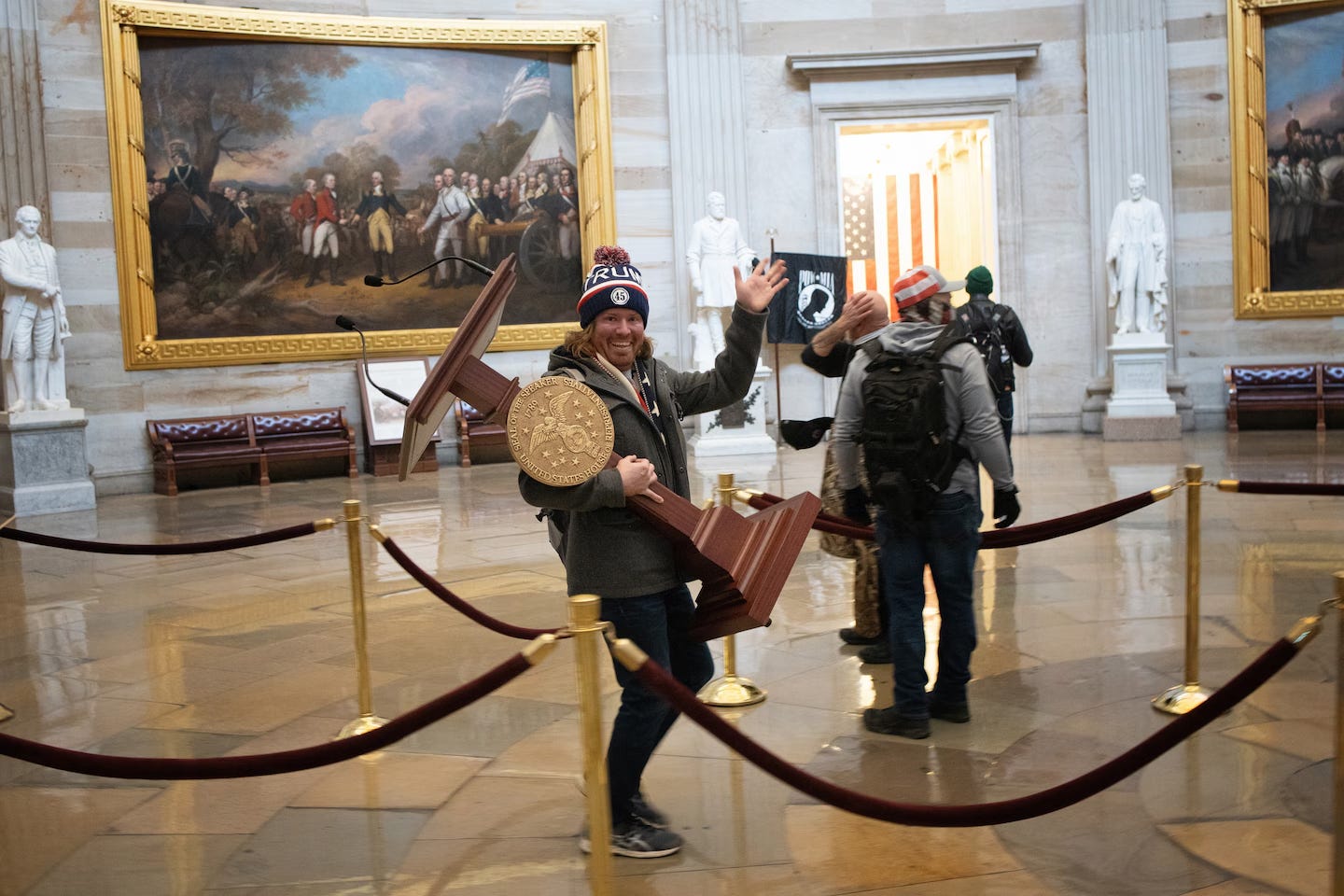
And that sums it up. January 6 is no longer something many on the right feel compelled to explain away. It is becoming a credential, a meme, a low-level launching pad into public office. What was once supposed to disqualify someone from democratic life is being folded back into politics as a matter of personality.
And if that sounds familiar, it should. The administration is doing something similar in court this week as it asks the Supreme Court to revisit birthright citizenship using arguments, The Washington Post reports, that rely in part on figures steeped in anti-Black and anti-Chinese racism.
That is the broader story right now. This is not just a government trying to govern badly. It is a government trying to normalize the ugliest parts of its project by laundering them through repetition, legal process, and spectacle.
One more thing to keep in mind this week
We’ll also be publishing a Survival Guide on what travelers need to know about ICE officers at airports, as the administration continues folding immigration enforcement into ordinary public life.
That is where we are. Millions in the streets, a blockade that wobbled, a Pentagon trying to scare reporters out of doing their jobs. And a January 6 meme candidate asking voters to call it all “normal.”
Protesting on behalf of illegal immigrants is crazy work.
https://torrancestephensphd.substack.com/p/no-kings-or-running-on-trump-derangement