



If you needed a single place to start this week’s Raid Report, it’s Minnesota.
Minneapolis has become a live test of what aggressive federal immigration enforcement looks like on the street, in real time, with cameras rolling, witnesses speaking, and public officials trying to control the story anyway. People keep using the word “fascism” because it’s the only one that describes the scenario accurately: armed agents with masks and swagger, a blizzard of official claims, and a public asked to doubt its own eyes.
Here’s what we know, what we can verify, and what we’re watching next.
Minnesota is ground zero, and the temperature is literal
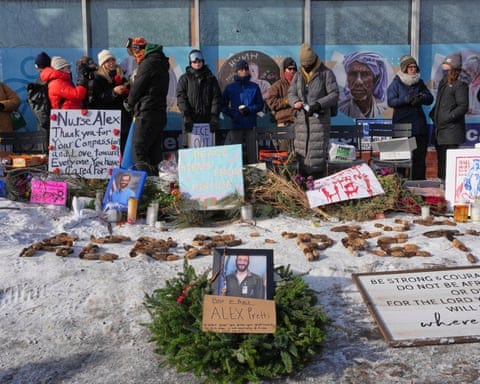
“The temperature hovered around zero degrees” as mourners and news crews returned to the site where federal agents shot and killed Alex Pretti. People built makeshift barriers after the shooting, then watched the city put up a perimeter, then watched the city reopen traffic and describe the overnight as “calm and peaceful,” according to The Guardian. Meanwhile, the memorial kept growing: “flowers, candles, and signs stuck into the snowbank and on the asphalt.” Spray paint reading “ICE OUT” and “Fuck ICE” appeared around the area.
A Saturday evening vigil drew “many hundreds of people in subzero temperatures.” “Last night, thousands of people came out to remember Alex Pretti and Renee Good,” Minneapolis mayor Jacob Frey wrote on Twitter. “The memorials and gatherings were peaceful, and there were no arrests and no reports of burglaries or fires.”
Then there’s the piece that rarely makes the press conference cut: Residents have built an “unofficial network of neighbors many thousands deep” to take kids to school, deliver groceries, and organise rides for people who fear traffic stops. That is what community defence looks like when the state feels threatened.
What happened to Alex Pretti, according to the government
Alex Pretti, 37, worked as an ICU nurse at the Minneapolis VA hospital, according to The Washington Post. His family described him as someone who cared “deeply for his family and friends and also the American veterans whom he cared for as an ICU nurse at the Minneapolis VA hospital,” in a statement shared with The Post. “Alex wanted to make a difference in this world.”
Federal officials framed his killing as justified almost immediately. Trump officials, including Homeland Security Secretary Kristi L. Noem, called Pretti a “domestic terrorist.” Noem said Pretti “came with weapons and ammunition to stop a law enforcement operation of federal law enforcement officers,” according to The Post.
The Guardian described a broader pattern in the messaging after the shooting: officials “prioritiz[e] the vilification of the dead victim” over preserving investigative neutrality, “regardless of conflicting evidence.” Assistant homeland security secretary Tricia McLaughlin sent a statement asserting that “the officers attempted to disarm the suspect, but the armed suspect violently resisted” and that “an agent fired defensive shots.” The Guardian also reported that White House senior adviser Stephen Miller posted: “A would-be assassin tried to murder federal law enforcement and the official Democrat account sides with the terrorists.”
What the video analysis and witnesses say happened
Here’s where the government narrative collides with the footage.
A Washington Post video analysis reported that “Federal agents who were wrestling a man to the ground in Minneapolis early Saturday had already secured a handgun he was carrying by the time they fatally shot him.” One agent emerged from the struggle holding Pretti’s gun, “having removed it from his waistband area.” “Less than a second later,” the first shots were fired.
Bystander footage showing Pretti filming with his phone. In one video, Pretti stands in the street “speaking to officers and filming them with his phone,” and “He is not holding a gun in either hand,” according to The Post. In another video, an officer pushes someone down onto the sidewalk. Pretti steps between them, the officer pepper-sprays him, and multiple agents move to force him to the ground. The Post reported that an agent in a gray jacket “reaches toward Pretti and lifts a gun from Pretti’s back near his waistband,” then turns away holding it.
Pretti’s family responded in the strongest possible terms. They called the administration’s description “sickening lies” and “reprehensible and disgusting.”
“Alex is clearly not holding a gun when attacked by [President Donald] Trump’s murdering and cowardly ICE thugs,” the family wrote. “Please get the truth out about our son. He was a good man.”
The Guardian’s reporting matches the same basic conflict: video “showed half a dozen officers taking Pretti, who had a phone, not a gun, visibly in his hand, to the ground,” while officials publicly suggested he intended to “massacre law enforcement.”
“It’s like Call of Duty”: the occupation aesthetic
The Guardian’s separate analysis framed Minneapolis as “a US city living under occupation by fascist presidential secret police right now,” quoting journalist and historian Garrett Graff’s Doomsday Scenario blog.
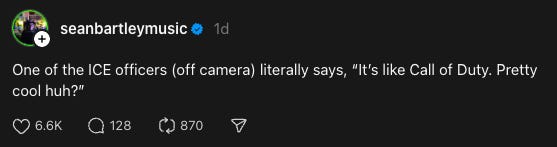
Several accounts describe federal agents wearing “helmets, gas masks and camouflage fatigues,” and quote audio from a TV mic capturing an agent saying, “It’s like Call of Duty,” followed by “So cool, huh?”
The article placed this moment in a brutal geographic context: Pretti’s killing happened “just over a mile” from where Renee Good was fatally shot on 7 January, and “less than a mile” from where police killed George Floyd in May 2020.
Minneapolis Police Chief Brian O’Hara called the situation untenable. “This is the second American citizen that’s been killed, third shooting within three weeks,” he told Face the Nation. “This is not sustainable.”
Pam Bondi’s letter: welfare rolls, sanctuary policy, voter rolls
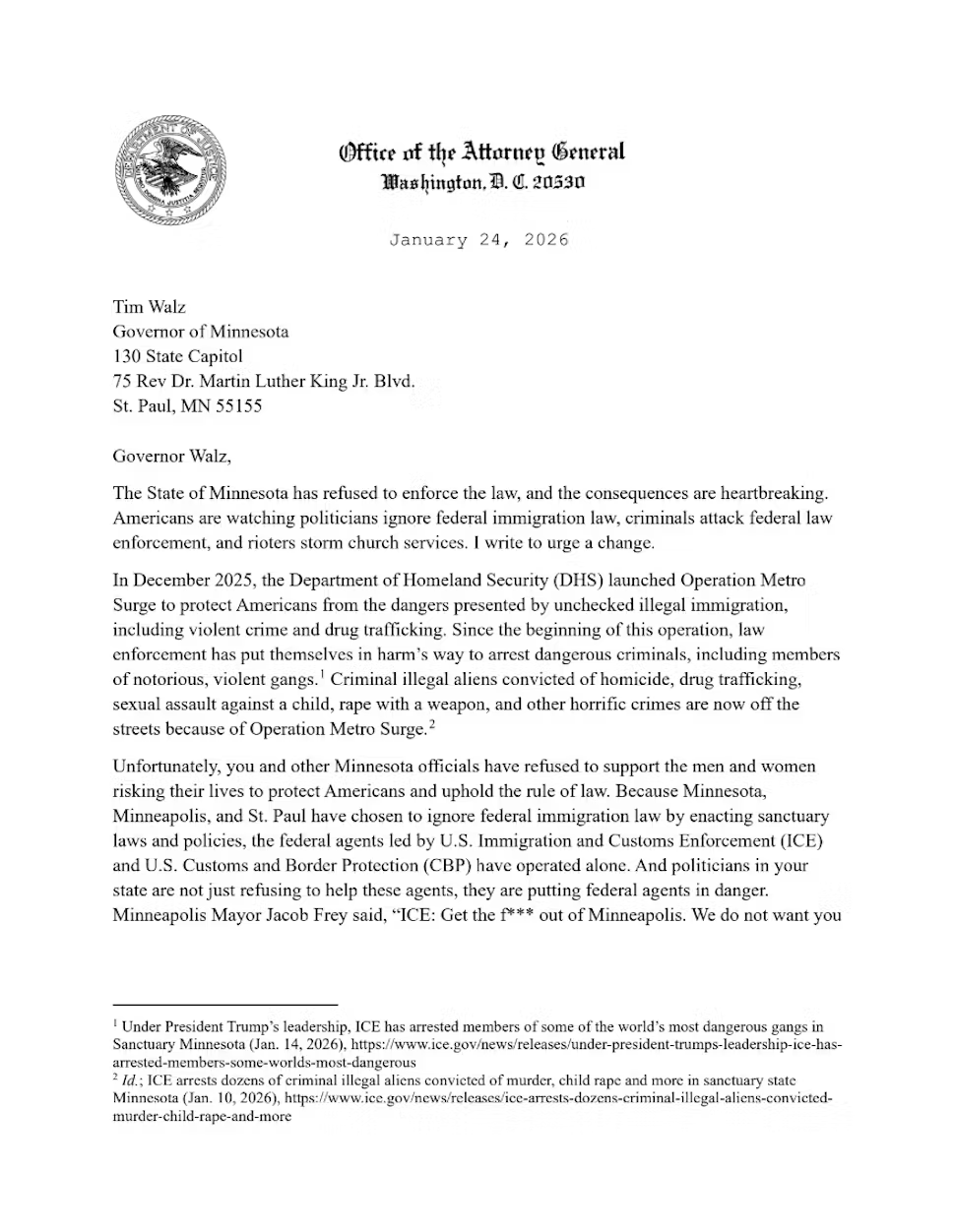
After the shooting, Attorney General Pam Bondi sent Minnesota Gov. Tim Walz a letter demanding sensitive state data.
In that letter, Bondi wrote: “The State of Minnesota has refused to enforce the law, and the consequences are heartbreaking.” She then argued that “Because Minnesota, Minneapolis, and St. Paul have chosen to ignore federal immigration law by enacting sanctuary laws and policies, the federal agents led by U.S. Immigration and Customs Enforcement (ICE) and U.S. Customs and Border Protection (CBP) have operated alone.”
Bondi also cited an increase in violence against ICE officers: “Violence against ICE officers and agents has increased approximately 1,300 percent,” and “Vehicular attacks against ICE officers have increased 3,200%.”
Then came three demands: “share all of Minnesota’s records on Medicaid and Food and Nutrition Service programs,” “repeal the sanctuary policies,” and “allow the Civil Rights Division of the Department of Justice to access voter rolls.”
Walz responded on X: “They think they can provoke us into abandoning our values. They are wrong. Minnesota believes in law and order. We believe in peace. And we believe that Trump needs to pull his 3,000 untrained agents out of Minnesota before they kill another American in the street.”
Congress voted on ICE funding anyway
While people freeze outside vigils in Minneapolis, Congress keeps doing what Congress does.
The New Republic reported that the Department of Homeland Security’s $64.4 billion bill passed 220–207, with seven Democrats voting in favor: Reps. Henry Cuellar, Tom Suozzi, Vicente Gonzalez, Laura Gillen, Marie Gluesenkamp Perez, Jared Golden, and Don Davis.
Suozzi acknowledged the optics, then voted yes anyway. “There is no question that ICE has overstepped its bounds,” he wrote online. Still, he said, “I am voting for the Department of Homeland Security appropriations bill, not to expand ICE enforcement or add more agents, but to fund the core operations Americans rely on every day, FEMA disaster response, TSA security, Customs and Border Protection, the Coast Guard, passport processing, and other essential services.”
Some Democrats pointed to provisions they described as guardrails, including “$20 million to outfit ICE personnel with body cameras,” plus cuts to some ICE enforcement lines and fewer detention beds.
Detention has shifted toward people with no convictions, according to UCLA researchers
If Minneapolis is the street-level story, the detention data shows the broader direction of travel.
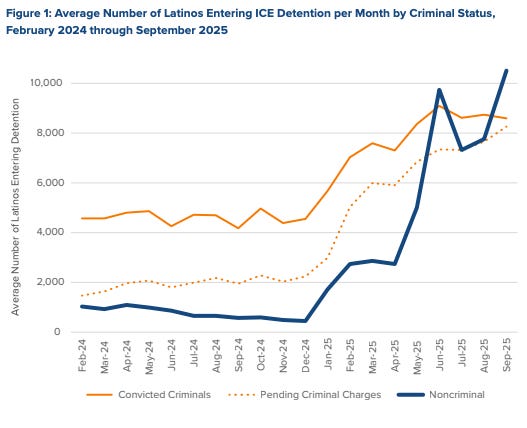
UCLA researchers found “monthly detentions of Latinos with no criminal records increased sixfold” compared to the final year of the Biden administration, rising “from about 900 per month to roughly 6,000, with a peak of nearly 10,500 in September 2025.” The analysis drew from the Deportation Data Project at UCLA and UC Berkeley Law, and reviewed ICE detention records from February 2024 through September 2025.
Researchers also found longer detention stays and more transfers: “nearly 7 in 10 noncriminal Latino detainees were held 15 days or longer,” with a median stay “more than 25 days,” and an estimate that “55% were transferred out of state.” Similarly, “nearly 9 in 10 noncriminal Latino detainees are ultimately deported.”
The authors warned the trend could move toward “mass confinement.”
The line we are watching this week (and you should, too)
Minnesota sits at the centre of this story because it offers something rare: a high-intensity enforcement campaign in a place where people document everything, organise fast, and refuse to accept the official script as the final draft.
This week, we’re watching four pressure points.
First, the gap between government claims and video evidence keeps widening. We will have a deep dive into the history of this.
Second, the political split inside “opposition” spaces, as Democrats argue over whether funding packages can be separated from how ICE operates in the real world.
Third, the expansion story beneath the headlines: detention shifting toward people without convictions, and longer detentions with frequent transfers. Stay tuned for our first Survival Guide to protect yourself and your loved ones.
Fourth, the money trail, because public anger does not stop at uniforms. It moves toward contracts, vendors, and corporate relationships, even when the first versions of those lists arrive in imperfect viral form.
If Minnesota is ground zero, the question is simple: Does the public’s evidence and resistance change the trajectory, or does Washington try to drown it out with funding, messaging, and fear?fop
The PEOPLE should not allow “The Consent of the Governed” to remain in solitary confinement
Are you familiar with the Diggers and the Levelers after the English civil war. Its were the Founder got there ideas.