


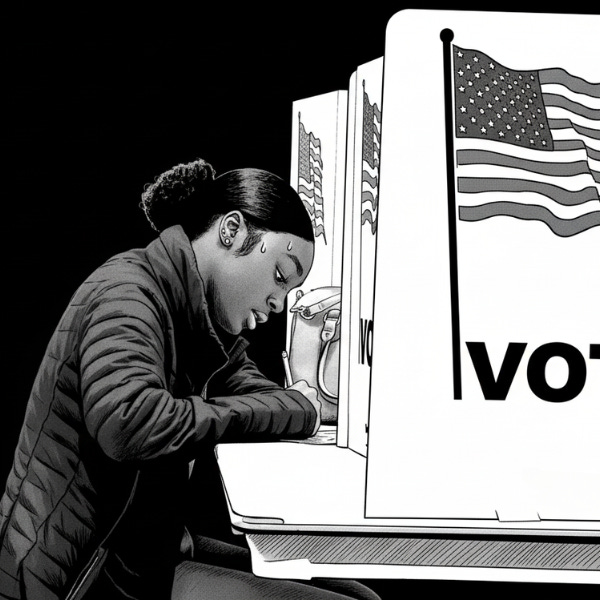
In our 121,487,563rd reason why we need a matriarchy, the U.S. House of Representatives has just passed an election overhaul bill that could make it harder for married women to vote.
It is yet another linguistic obsession of the government to “save” America. This time, it is the proposed SAVE America Act, which passed its first hurdle in the House last Wednesday. The proposal would impose strict limitations on voter registration and voting, including new rules that voting rights groups warn could trip up married women and LGBTQ+ people who have changed their names.
The only vote in favor by the Democratic Party was that of Texas Representative Henry Cuellar.
The bill that says “SAVE” while building a paperwork trap
According to The 19th, the SAVE America Act would require voters to provide documents proving citizenship at the time of registration and would layer additional ID rules on top. Critics say the combo creates a bureaucratic bottleneck for otherwise eligible citizens, especially in rural areas and among people with limited access to the required documents.
The problem is not theoretical. The 19th reported that voting rights groups have warned the bill would pose a barrier for millions of Americans who have changed their legal names due to marriage, assimilation, or gender identity, since key documents like birth certificates often do not match a person’s current legal name.
And if the point is “election integrity,” it is worth saying plainly: noncitizen voting is already illegal, yet the GOP keeps writing legislation as if it is standard practice.
Married women are not collateral damage. They are the target audience.
Proponents of the bill have scoffed at the idea that the act would meaningfully affect married people who have changed their names.
GOP Rep. Tim Burchett, a vocal advocate of the bill from Tennessee, said the concept of married women not being able to vote under the act was “ridiculous.”
“It’s an easy change — there’s no problem with that at all,” Burchett told The 19th. “That’s just like saying it’s Jim Crow. That’s an antiquated argument that nobody buys.”
But the bill’s critics are not imagining an obstacle. They are describing how bureaucracy works in real life: missing documents, mismatched names, inconsistent state systems, wait times, fees, confusion, and the quiet exhaustion that makes people give up.
As New Mexico Rep. Teresa Leger Fernandez put it: “A real solution would eliminate the provision that requires women to go around and gather all these documents only to then affirm their own identity.”
The “SAVE” brand is the story. They keep using it for a reason.
If you have read the Heritage Foundation’s January special report, “Saving America by Saving the Family,” the SAVE America Act lands less like an isolated voting bill and more like a familiar chapter title.
Heritage frames its project as “justice,” driven by “two truths,” including this one:
“The first is that all children have a right to the affection and protection of the man and woman who created them.”
It follows with a second “truth” that narrows the acceptable household into one moral template:
“The second is that the ideal environment in which to exercise this right is in a loving and stable home with their married biological parents.”
That report defines marriage as “the committed union of one man and one woman” and calls it the cornerstone of civilization. While the language sounds philosophical, the impact is administrative. Once a movement convinces itself that “saving” the country requires policing the terms of family life, it starts treating women’s autonomy as a system’s failure, not a right.
So when a bill appears that could make it harder to register and vote after a name change and has the same wording in its title, of course we are going to panic.
“Election integrity” has always been the vehicle. Control is the destination.
The SAVE America Act fits inside a broader, increasingly explicit GOP strategy to cast doubt on elections, tighten registration, and normalize federal intrusion into voting systems, even as Trump openly floats the idea of “nationalizing” voting.
Even some Senate Republicans have expressed concern. Alaska’s Lisa Murkowski warned against one-size-fits-all mandates from Washington and said the push is “not how we build trust.”
And yet, the political logic remains consistent: when you cannot win on persuasion, you try to win on friction. You create obstacles that feel “reasonable” in a press release and punishing at the DMV. You call it security, but in reality, you are deciding who has the time, money, documents, and stamina to participate in democracy.
The point is to make participation feel risky
Here is the emotional math these bills rely on: If you are a married woman with a changed name, you start doing the calculus: Do I have the right paperwork? Do I have time off work to fix it? What if I get turned away? What if I get flagged? What if I make a mistake?
If you are LGBTQ+ and you changed your name to better align with your identity, the stakes escalate.
And once enough people decide it is safer to sit out than to fight an administrative maze, the bill succeeds without ever needing to say the quiet part out loud.