


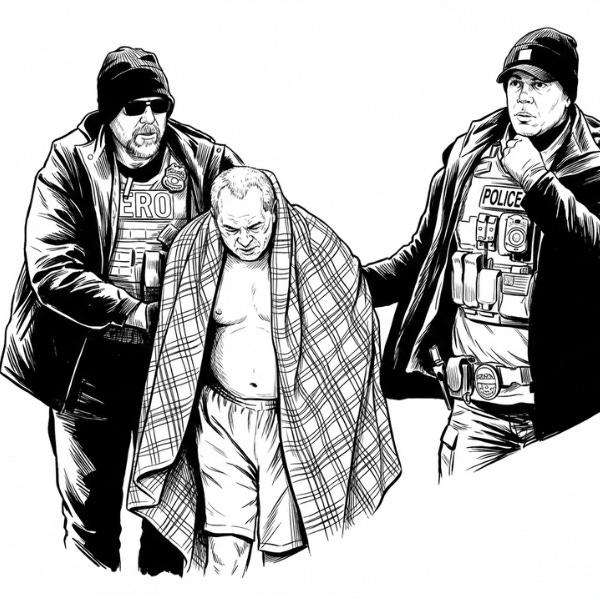
If you have felt your stomach drop every time you see a black SUV and a vest that says “POLICE,” you are not being dramatic. This week’s ICE crackdown stories share the same undertone: speed over process, force over clarity, and a government that keeps asking the public to trust it while it fights accountability in court.
Here is what happened, according to reporting, court filings, and oversight visits across the country.
First, ICE showed up at a citizen’s door
On Sunday in St. Paul, Minnesota, ChongLy “Scott” Thao, a naturalized U.S. citizen, says masked federal agents forced their way into his home with guns drawn, without showing a warrant, and detained him while he wore almost nothing in subfreezing weather. “I was shaking,” Thao told the Associated Press. “They didn’t show any warrant; they just broke down the door.”
As neighbors shouted and a small child cried, agents walked Thao outside in sandals and underwear, with a blanket wrapped around his shoulders. He says they drove him “to the middle of nowhere,” made him get out in the cold so they could photograph him, and later returned him without apologizing.
DHS says the raid targeted two convicted sex offenders and claims Thao “matched the description of the targets,” adding that he “refused to be fingerprinted or facially ID’d.” Thao’s family “categorically disputes” DHS’s account, calling it “false and misleading.”
Then the paperwork caught up with the raid
Thao’s case did not land in a vacuum. It hit a Twin Cities region already bracing for a surge of federal immigration activity and protest. In the same stretch of reporting, federal officials framed enforcement as targeted, while local leaders described something broader and more indiscriminate.
St. Paul Mayor Kaohly Her put it bluntly: “ICE is not doing what they say they’re doing.” She added, “They’re not going after hardened criminals. They’re going after anyone and everyone in their path. It is unacceptable and un-American.”
That disconnect between what officials say and what residents experience is where the fear multiplies, because it forces everyone else to guess the rules in real time.
ICE detention keeps expanding, and bodies keep stacking up
While the raids grab headlines, detention stays the engine.
This week brought fresh reporting on deaths at Camp East Montana, the sprawling tent-style detention facility at Fort Bliss in El Paso. NBC News reported that ICE announced a third detainee death there in 44 days, identifying the person as Victor Manuel Diaz, 36, from Nicaragua. ICE said staff found him “unconscious and unresponsive,” and the agency described it as a “presumed suicide,” while noting the official cause remained under investigation.
At the same facility, the death of Geraldo Lunas Campos, 55, has drawn intensifying scrutiny. The Washington Post reported that a medical examiner is likely to classify his death as a homicide, citing preliminary findings of asphyxia due to neck and chest compression, and describing a recorded call shared by his daughter.
When detention expands at speed, oversight and medical care become stress tests. The system does not just detain more people. It creates more moments where something goes wrong, and then asks families to accept official narratives while investigations crawl.
Congressional oversight ran into a locked door
If you have wondered why lawmakers keep showing up at detention sites with cameras and press gaggles, this is part of the answer: the administration keeps trying to control access.
The Guardian reported that a federal judge in Washington, D.C., ruled DHS can temporarily continue requiring lawmakers to give a week’s notice before inspecting immigration facilities, even after she blocked an identical policy last month. The judge, Jia Cobb, said DHS argued this version runs through different funding, tied to Trump’s “big, beautiful bill,” making it a “new agency action” that would require a different legal challenge.
That legal distinction might sound technical. In practice, it buys the government time and reduces the risk of real-time, unannounced scrutiny within detention spaces that already operate behind layers of bureaucracy.
In California, senators walked through what used to be a prison
While access fights played out in court, Democratic Sens. Alex Padilla and Adam Schiff went inside California’s newest and largest ICE detention center, a former prison now operated by CoreCivic in California City, in the Mojave Desert.
CalMatters reported that more than 1,400 people are currently held there, and both senators highlighted what they described as inadequate medical care. “The most frequent feedback we got was the inadequacy of the medical care they are receiving,” Schiff said. He described meeting a diabetic detainee who “has not received treatment for her condition in two months.” “That’s frightening,” he said.
Padilla also emphasized that many detainees have civil immigration cases, not criminal convictions, while describing prison-like conditions and mental health concerns: “This is not a prison, despite the environment, so we have an equal concern for mental health care.”
ICE family detention is back, and kids are getting sick
PBS NewsHour reported on court documents and allegations from migrant families about children’s conditions in ICE custody, including “Food contaminated with worms and mold,” “limited access to clean drinking water,” and “inadequate medical care.” Senior lawyer Becky Wolozin of the National Center for Youth Law told PBS that, since family detention centers reopened, authorities have arrested many families from inside the U.S.: “These are your neighbors, your friends, your kids’ friends.”
Wolozin described children deteriorating in prolonged detention, and she pushed back on a DHS claim in court filings that ICE provides humane care: “It’s just not true.” She said conditions do not meet the Flores Settlement Agreement’s basic requirements for “safe and sanitary conditions” for children.
Even in the narrowest legal framing, the U.S. has obligations when it holds children. The allegations describe the opposite of stability.
Local governments are starting to kick ICE out
Some pushback is now coming through leases, not speeches.
CBS News Philadelphia reported that Lehigh County, Pennsylvania, is terminating its lease agreement with DHS for county-owned office space used by ICE, after officials said the federal agency had not been paying rent. County Executive Josh Siegel said DHS “should consider themselves evicted,” while the county controller said DHS and ICE owe more than $100,000 in unpaid rent.
Call it a rent dispute if you want. Still, the language from county officials made the political subtext explicit: local governments do not want to look complicit in what residents see on their screens from places like Minneapolis.
So, where does that leave people trying to live their lives?
Across all of this, a pattern keeps repeating: federal agencies scale up enforcement, communities document harm, and then the accountability fight begins in court, in Congress, and in the mundane paperwork of budgets and access rules.
That is why the fear feels ambient right now. This is not only about who gets detained. It is also about how quickly the state can move, how little it has to explain in the moment, and how hard it can be to force transparency after the fact.