


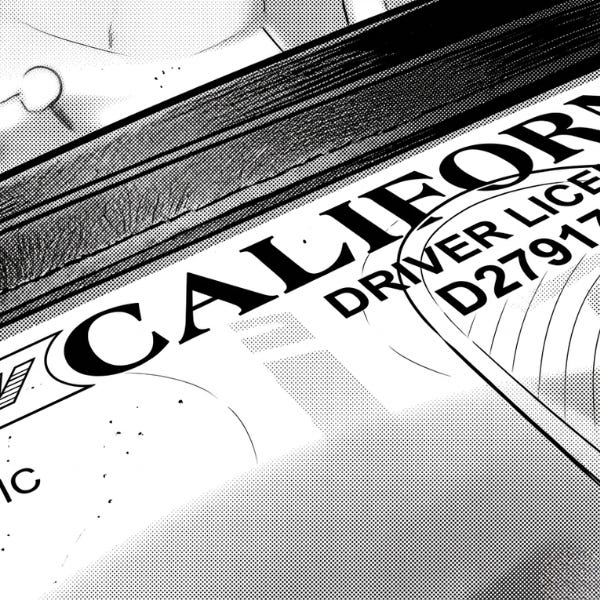
Many people are calling it a “betrayal” as California plans to share detailed information about driver’s license holders with an outside group. This includes immigrants who do not have legal authorization to live in the U.S.
For over ten years, California and 18 other states have encouraged undocumented people to get driver’s licenses to improve public safety and help the economy. Economists say these laws increase economic activity, add billions in tax revenue, and make communities safer because people without legal status may feel safer reporting crimes.
More than one million people have obtained driver’s licenses in California under Assembly Bill 60, a law passed in 2013. The law prohibits the state from using information obtained during the licensing process to determine a person’s citizenship.
But the multi-state verification system can show if someone is undocumented. A manual obtained by CalMatters says the database will include the last five digits of a person’s Social Security number. If someone does not have one, states can use “99999” as a placeholder.
Civil rights advocates are raising concerns. They say this move “breaks a promise” California made ten years ago when it started giving permits to undocumented immigrants. Now, over a million people could face a higher risk of deportation.
Advocates say that after a recent meeting with the California DMV and Governor Newsom’s office, they learned that if the state does not share the data, the Department of Homeland Security might stop accepting California permits and IDs at airports.
All they need is a Social Security number.
CalMatters reported that four advocacy groups at the meeting said the shared information will show if someone has a Social Security number. This could be used to identify people who are in the country without legal status.
The state plans to give the information to the American Association of Motor Vehicle Administrators, a nonprofit run by DMV officials from around the country. The information provided to the association will be incorporated into the group’s interstate verification system and its platform, SPEXS, which allows DMVs and contractors working with them to verify whether someone holds more than one driver’s license issued in their name. Sharing this data allows agencies that issue driver’s licenses to confirm that a person does not hold duplicate licenses in multiple states.
In the future, a database like this could be used for mobile driver’s licenses on iPhones, online age checks for adult content, or even chatbots.
But advocates worry that federal immigration officials might try to get large amounts of this data and use missing Social Security numbers to target people for deportation.
The state, for its part, assures there will be safeguards.
The association told the state it will add security measures to stop mass searches of unauthorized immigrant driver’s license holders and block access by Border Patrol and ICE, according to people at the DMV and the governor’s office briefing. Still, many remain skeptical.
“Once this data is uploaded to AAMVA, it’s out of California’s control, no matter what California wants, no matter what protests we may make,” said Ed Hasbrouck of the San Francisco civil liberties group The Identity Project, who was on the briefing call.
Similarly, in a statement to the Washington Examiner, a spokeswoman for Newsom asserted that claims the data sharing could negatively affect undocumented immigrants “are lies.”
“CalMatters got it wrong. Their reporting hurts vulnerable Californians by manufacturing fear and panic with lies,” the spokeswoman said. “California continues to lead in supporting immigrant families and protecting personal data from federal overreach.”
This warning has been building for a long time.
As the Examiner explained, the news comes at a time when the California DMV has faced months of criticism from both the Trump administration and state officials. Several states are engaging in “systemic noncompliance” with regulations regarding commercial driver’s licenses for non-residents.
California and other DMVs across the country have been “illegally” issuing commercial driver’s licenses that allow truckers to remain on the road and retain that privilege after their legal status or work permits have expired, among other issues, according to Transportation Secretary Sean Duffy.
In January, the secretary said he would withhold $160 million in federal funds allocated to California after the state refused to revoke 17,000 licenses. In a March update, the California DMV indicated that the government is revoking 13,000 commercial driver’s licenses held by non-residents, effective immediately.
It won’t be cheap
To move forward with sharing data, the California Legislature must approve $55 million for the DMV’s costs. Lawmakers may also need to change the current law, which says Social Security numbers collected by the DMV can only be shared to address unpaid taxes, parking tickets, or child support.
A spokesperson for the governor’s office would not confirm details of the call or respond to the specific concerns raised by advocates.
“California continues to lead in supporting immigrant families and protecting personal data from federal overreach,” the spokesperson, Diana Crofts-Pelayo, wrote in an email. “The state has taken the same approach to protect Californians’ data during the Real ID implementation, while maintaining Real ID compliance for the benefit of all Californians.”
Ian Grossman, executive director of the American Association of Motor Vehicle Administrators, told CalMatters that participation in the verification system is voluntary and that only authorized state employees or contractors have access to it, that bulk searches are currently not permitted, and that all searches must include specific information about an individual, such as their name and date of birth.
The state’s past actions do not inspire confidence.
CalMatters reported last year and again this year on cases in which local law enforcement violated state law and shared information collected by automatic license plate readers with ICE or Border Patrol agents.
The DMV and the governor’s office say the association will notify California of requests from any entity other than a participating state, including attempts to subpoena the database for information on California license holders, giving the state the opportunity to challenge the subpoenas or intervene in other requests. But if a subpoena is accompanied by a gag order, the association would be unable to provide such notification.
An agreement between the association and the California DMV obtained by CalMatters states that the association will inform California “if legally permitted” if it receives a subpoena “to release, disclose, discuss, or obtain access to S2S information.”
However, for Tracy Rosenberg, advocacy director at Oakland Privacy, who participated in the call, the questions remain unanswered.
“It’s unclear how extreme the danger people are being put into by this decision, but there’s no doubt we told people with AB 60 licenses this would never happen. But it’s happening, and that’s a direct betrayal,” she said.