


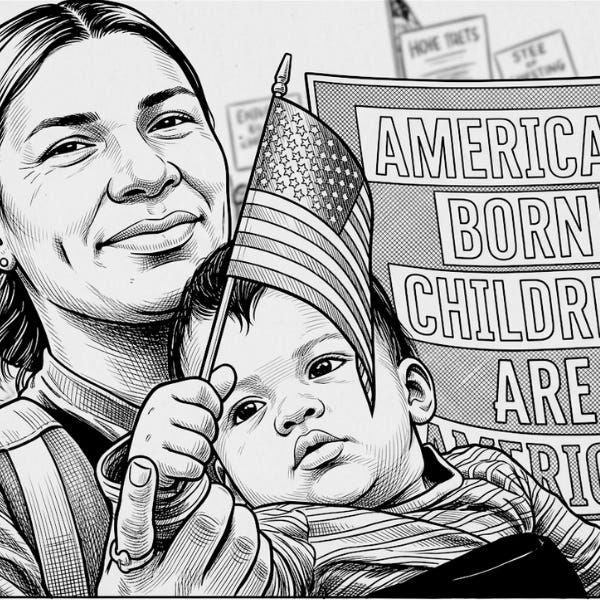
Tomorrow, the Supreme Court will hear one of the most consequential immigration cases in years. On paper, it is about whether Donald Trump can use an executive order to end automatic citizenship for some babies born in the United States. In practice, it is about something much larger: whether the Court is willing to reopen one of the country’s most settled constitutional guarantees, and in doing so create a new class of children whose legal status would depend on who their parents are.
Trump’s order, signed on his first day back in office, says children born in the U.S. would no longer automatically be citizens if their parents are undocumented or in the country temporarily, including on student or work visas. Lower courts have uniformly blocked the order from taking effect, and the Supreme Court agreed to take the case before the appeals process had fully played out. A decision is expected by late June or early July.
What the Court is actually being asked to decide
The formal question is whether Trump’s order is consistent with the Citizenship Clause of the 14th Amendment, which says that all persons born in the United States and “subject to the jurisdiction thereof” are citizens. For more than a century, that clause has been understood to cover nearly everyone born on U.S. soil, with only narrow exceptions such as the children of diplomats and foreign enemies. That understanding was cemented by the Supreme Court’s 1898 decision in United States v. Wong Kim Ark.
The Trump administration is asking the justices to adopt a much narrower reading. Solicitor General D. John Sauer argues that the 14th Amendment was meant to protect freed slaves and their children, not the children of people in the country unlawfully or temporarily, and that the phrase “subject to the jurisdiction thereof” should be read to require a more complete form of allegiance to the United States. Opponents say that it is an attempt to rewrite settled law by executive order.
That is the clean constitutional fight. But there is a second path the justices could take.
The quieter issue that could decide the whole case
As The Hill points out, the Court does not necessarily have to resolve the full constitutional question tomorrow. Congress codified birthright citizenship in federal law in 1940, and then again in the Immigration and Nationality Act of 1952, using language that closely tracks the 14th Amendment. That gives the justices a narrower off-ramp: they could rule that Trump’s order conflicts with federal statute even if they avoid saying anything sweeping about the Constitution itself.
That point is crucial because this Court, and Chief Justice John Roberts in particular, has sometimes preferred narrower rulings when a broader constitutional one is not strictly necessary. A statutory ruling would still block Trump’s order. It would also let the Court sidestep, at least for now, a frontal collision with more than a century of constitutional understanding.
Of course, that would not end the politics. It would simply move the fight back to Congress, where Republicans have spent years trying to restrict birthright citizenship and where support for that effort has grown, even if the legislation still has not moved.
The administration’s argument is not just aggressive. It is historically loaded.
There is another reason this case feels so ominous. According to The Washington Post, the Trump administration’s Supreme Court brief leans in part on arguments advanced by late-19th-century figures such as Alexander Porter Morse, Francis Wharton, and George D. Collins, men whose campaigns against birthright citizenship were steeped in anti-Black and anti-Chinese racism. Scholars quoted by the Post say the administration is reviving ideas that emerged from efforts to narrow Reconstruction-era citizenship and keep Chinese immigrants and their children outside the national body politic.
That historical backdrop matters because it clarifies what is being presented as a technical dispute about constitutional meaning. The argument Trump is pushing did not emerge from some neutral, long-lost legal tradition. It grew out of an older effort to decide that some people born here still did not belong here.
That does not automatically decide the case. But it tells you something about what kind of history the administration has chosen to elevate, and why so many legal historians hear alarm bells in this brief.
John Eastman is back in the room, even if his name is not on the brief
And then there is the man behind the theory.
According to Politico, John Eastman has been trying to end birthright citizenship for decades. Long before he became nationally known for helping devise Trump’s attempt to overturn the 2020 election, Eastman was writing op-eds, law review articles, and testimony arguing that the 14th Amendment does not guarantee citizenship to virtually everyone born on U.S. soil. Politico describes him as the longtime intellectual engine behind this effort, even though the administration’s briefs do not openly credit him.
In short, the same lawyer whose legal theories became shorthand for constitutional extremism after 2020 is also the leading evangelist for this one. That does not make the administration’s argument legally impossible on its own. But it does tell you what ideological ecosystem it comes from, and how long this project has been waiting for the right Court and the right presidency to try again.
The babies keep disappearing from the argument
One of the sharpest critiques of this case came from NPR, which noted how rarely the people most directly affected are centered in the debate. According to Bruce Lesley of First Focus on Children, this is “birth” right citizenship. This is about babies. But public argument around the case has focused instead on administrative burdens, historical meaning, political allegiance, and immigration deterrence.
NPR reports that under the current system, babies born in U.S. hospitals are automatically folded into a network of legal and administrative protections: Social Security numbers, Medicaid eligibility, food benefits, and continuity of care. If birthright citizenship were narrowed, every family could be forced into a proof regime that does not currently exist, with the citizenship of newborns depending on documents, parental status, and bureaucratic determinations made at the most vulnerable moment in a child’s life.
Regarding the consequences, NPR notes that around 3.6 million babies are born in the U.S. each year, and that all parents, not just immigrant parents, could face new documentation hurdles if automatic citizenship disappears. Lawyers have also warned of especially chaotic outcomes for babies with unknown fathers, foundlings, children born through surrogacy or assisted reproductive technology, and families whose records are incomplete or destroyed.
In the end, once you make citizenship at birth conditional, you are no longer simply arguing about constitutional text. You are building a bureaucracy of suspicion around newborns.
How many children are actually at stake
Similarly, CBS reports that the Migration Policy Institute and Penn State’s Population Research Institute estimate more than 250,000 babies each year would be affected by Trump’s order. California Attorney General Rob Bonta told CBS that between 20,000 and 24,000 babies in California alone could lose citizenship annually, while states would also lose federal funding tied to children’s eligibility for programs such as Medicaid and CHIP.
And the concern does not stop with future births. Advocates told CBS that if the Court accepts the administration’s reading of the Citizenship Clause, it could invite broader challenges to the citizenship of millions of Americans and fuel even more aggressive efforts to question who belongs. That is why opponents keep stressing that this case is not just about one executive order. It is about whether the Court opens the door to a much wider culture of doubt about citizenship.
Public opinion is split, but not in a simple way
NPR’s latest survey round-up shows the politics here are more complicated than the White House would like. General support for birthright citizenship remains relatively strong when people are asked about it as a constitutional principle, but support drops sharply when poll questions focus specifically on undocumented parents or temporary visitors. The divide is also steeply partisan and racialized: Democrats, younger voters, Black Americans, and Latinos are much more likely to support birthright citizenship, while Republicans, especially white Republicans, are much more likely to oppose it.
That split matters because it helps explain why the administration is pushing so hard on this case. Birthright citizenship is one of those issues where long-settled law collides with a public that is unevenly informed and often responsive to how the question is framed. It is also one of the clearest examples of how immigration politics in the United States works: present a constitutional guarantee as a loophole, describe newborns as incentives, and then ask the Court to do what Congress never quite managed to do.
What tomorrow’s hearing is really about
Tomorrow’s argument is nominally about text, history, and precedent. But the deeper conflict is over what kind of country the Court thinks the 14th Amendment created after the Civil War.
The traditional understanding of birthright citizenship says that if you are born here, you enter the political community here. You are not required to inherit your parents’ legal precarity. You do not begin life having to prove that you belong. That is part of what made the Citizenship Clause so powerful after Dred Scott, and part of why Wong Kim Ark became so central in the first place.
Trump’s order asks the Court to move in the opposite direction. It asks the justices to treat birthplace as insufficient, parental status as decisive, and constitutional bedrock as flexible enough to be narrowed by a president on day one.
Nice read on BRC
https://torrancestephensphd.substack.com/p/about-this-birtright-citizenship