


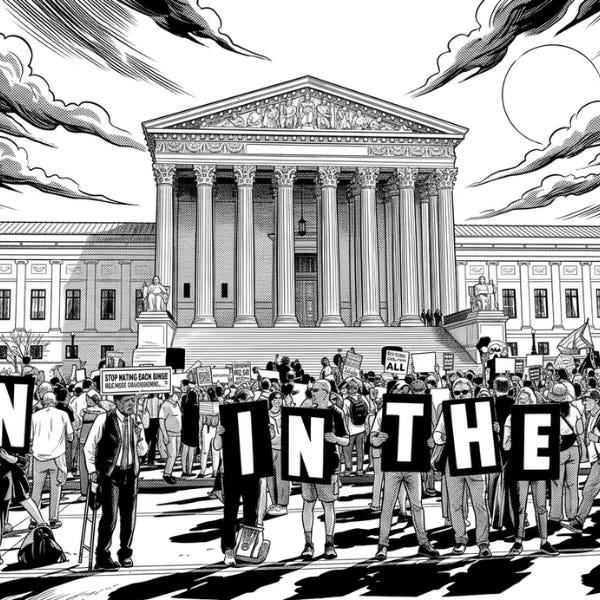
Four days before the United States turns 250, the Supreme Court reaffirmed one of the most foundational promises the country ever made.
In a 6-3 decision on Tuesday, the court ruled that the Constitution guarantees automatic birthright citizenship to virtually all children born in the United States, striking down the executive order President Trump signed on the first day of his second term, according to NPR. Chief Justice John Roberts wrote the majority opinion, and his closing line was worth reading slowly.
“Citizenship, then and now, was the right to have rights — to freely participate in our political community,” Roberts wrote. “The Framers of the Fourteenth Amendment extended that promise to ‘every free-born person in this land.’ We keep that promise today.”
This is a genuine constitutional victory. And it is complicated.
The 14th Amendment Has Meant This for More Than 150 Years
The Trump administration staked its argument on four words: “subject to the jurisdiction thereof.” Those words appear in the 14th Amendment, and the administration argued they should exclude children born to parents without permanent legal status. People “domiciled elsewhere, and only temporarily present in the United States, owe primary allegiance to their parents’ home countries, not the United States,” the administration argued, according to the BBC.
Roberts’ opinion rejected that reading entirely, pointing to the court’s landmark 1898 ruling in the case of United States v. Wong Kim Ark. Wong Kim Ark was born in San Francisco in 1873 to Chinese immigrant parents who ran a business there. When he tried to return to the United States in 1895 after visiting his family in China, the government denied him entry on the grounds that he was not a citizen. He challenged that denial and won in the Supreme Court. That precedent held so firmly that even during World War II, when Japanese Americans were held in internment camps, children born in those camps were automatically granted citizenship.
The ACLU’s Cecillia Wang, herself a birthright citizen born to Chinese parents, argued the case before the court. “In America, we do not punish children for the sins of their fathers, but instead we wipe the slate clean,” she said, according to NPR. “When you’re born in this country, we’re all American, all the same.”
Three Justices Voted to Make Newborn Babies Stateless
The 6-3 breakdown matters. Five justices joined Roberts’ constitutional ruling. A sixth, Justice Brett Kavanaugh, agreed the executive order was unlawful but on statutory grounds, finding it violated federal legislation enacted in the 1950s rather than the Constitution itself. That distinction is significant: had the ruling rested on Kavanaugh’s narrower reasoning alone, a simple act of Congress could have achieved what the executive order could not.
Justice Clarence Thomas wrote the lead dissent, a 91-page argument that the 14th Amendment was only ever meant to apply to formerly enslaved people and their descendants, an interpretation that aligns with Trump’s own stated position, according to NPR. Justice Neil Gorsuch joined Thomas’s dissent. Justice Samuel Alito wrote separately.
Justice Ketanji Brown Jackson answered Thomas directly. “Despite his longstanding endorsement of a colorblind society, Justice Thomas now surprisingly suggests that the citizenship clause was a race-conscious remedial measure relating only to freed slaves,” she wrote, according to NPR.
Lynn Tramonte, Executive Director of the Ohio Immigrant Alliance, explained the weight of that dissent. “It is terrifying to know that three U.S. Supreme Court Justices voted to make society’s most vulnerable people — babies — stateless or second-class citizens, simply because of who their parents are,” she said in a statement.
Trump Lost the Case. The Fight Is Not Over.
Within hours of the ruling, Trump posted on Truth Social, calling the decision “too bad for our Country” and urging Congress to pass legislation achieving the same result as his now-defunct order, according to NBC News. “Congress should start TODAY,” he wrote.
That path faces substantial obstacles. Republicans hold 53 Senate seats, but passing legislation would require 60 votes under current filibuster rules, according to NBC News. A constitutional amendment would require two-thirds of both chambers of Congress and ratification by three-fourths of the states, Sen. John Cornyn, R-Texas, noted in a post on X shortly after the ruling.
White House deputy chief of staff Stephen Miller called the decision “one of the most destructive and outrageous decisions in the long history of the Supreme Court,” according to NBC News. Sen. Eric Schmitt of Missouri announced he would introduce a constitutional amendment modeled on the defeated executive order.
The legislative path is, for the moment, closed. But this administration has shown that when one door is locked, it looks for windows.
The Same Week, the Court Left 1.3 Million TPS Holders Exposed
This is where the victory becomes impossible to celebrate without qualification.
In the same week the court upheld birthright citizenship, it also ruled in Trump v. Miot and Mullin v. Doe that federal courts cannot review the termination of Temporary Protected Status, clearing the path for the administration to strip protections from roughly 1.3 million people, according to Communities United for Status and Protection, known as CUSP.
That number includes the parents of some of the very children whose citizenship was secured on Tuesday.
“A family can be told in the same week that its child belongs here and that its mother does not,” CUSP said in a statement. “That is not a contradiction the law should ever produce — and it is the clearest proof that these fights were never separate.”
Carolyn Tran, Executive Director of CUSP, was direct: “Birthright, TPS, DACA — one fight, same families, one demand: citizenship now.”
This week also marks the 14th anniversary of DACA, according to CUSP. The program remains under sustained pressure from the same administration that just lost on birthright citizenship.
Four Days Before the 250th Anniversary, the Court Remembered What America Is Supposed to Be
Approximately 38 million second-generation Americans, people born in the United States to at least one immigrant parent, are part of the fabric of this country, according to HOPE, a nonprofit focused on Latina leadership. Tuesday’s ruling secured the foundation beneath all of them.
Democratic representatives Adriano Espaillat, Yvette Clarke, and Grace Meng, who chair the Congressional Hispanic, Black, and Asian Pacific American caucuses, tied the ruling directly to the anniversary. “As we approach the 250th anniversary of our nation’s founding, we stand united in rejecting Trump’s dangerous and exclusionary vision of America,” they said in a joint statement.
Janet Murguía, President and CEO of UnidosUS, the nation’s largest Hispanic civil rights organization, framed it in constitutional terms. “No presidential pen can outweigh the heart of our constitution,” she said in a statement.
New York City Mayor Zohran Mamdani echoed the sentiment. “This should never have been in doubt,” he said. “The federal administration sought to rewrite one of the clearest guarantees in our Constitution in an effort to decide who belongs in this country and who does not. Today, the Court rejected that effort.”
They are right to celebrate. And they are right to keep fighting.